
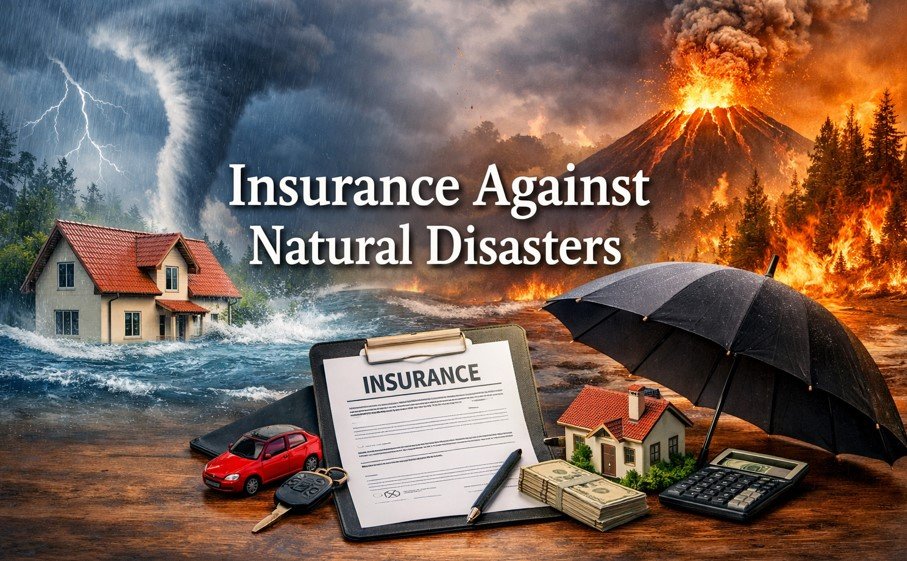
Insurance against natural disasters has transformed from a luxury add-on to a fundamental pillar of modern financial planning.
As global weather patterns become increasingly volatile and seismic activity remains a constant threat, the necessity of securing your assets has never been more urgent.
Insurance against natural disasters provides a critical safety net that ensures a single catastrophic event doesn’t lead to permanent financial ruin.
Whether you are a homeowner guarding your sanctuary or a business owner protecting your livelihood, understanding the nuances of disaster-specific coverage is the first step toward true resilience.
The Rising Need for Comprehensive Coverage
Insurance against natural disasters is no longer a “set it and forget it” component of a financial portfolio. It has become a dynamic necessity in an era of rapid environmental shifts.
As we navigate the complexities of the mid-2020s, the traditional boundaries of risk have blurred. This makes comprehensive coverage the only logical defense against an increasingly volatile planet.
Insurance against natural disasters must now account for a “new normal” where historical data is often an insufficient predictor of future catastrophe.
To truly understand why basic policies are falling short, we must examine the intersection of climate instability, economic inflation, and the evolving geographical reach of modern perils.
The Escalation of “Billion-Dollar” Secondary Perils
For decades, the insurance industry focused primarily on “primary perils”; massive, headline-grabbing events like major hurricanes or cataclysmic earthquakes. However, the rising need for comprehensive insurance against natural disasters is now driven by “secondary perils.”
These are smaller-to-medium-sized events, such as localized flash flooding, severe hailstorms, and drought-induced wildfires, which are occurring with staggering frequency.
Individually, they may not dominate the international news cycle, but collectively, they are causing cumulative damages that rival the largest hurricanes.
Comprehensive coverage ensures that a policyholder isn’t just protected against the “once-in-a-century” event, but also against the “three-times-a-decade” storms that can slowly erode financial stability through repeated deductibles and unreimbursed repair costs.
The Urbanization of High-Risk Zones
As global populations grow, the “human footprint” is expanding into areas that were once considered natural buffer zones. We are building homes in “wildland-urban interfaces” prone to fire and developing coastal plains that were originally meant to absorb storm surges.
This migration pattern has created a massive concentration of value in harm’s way. When a disaster strikes these densely populated corridors, the economic fallout is exponential compared to twenty years ago.
Standard insurance often fails to recognize the specific vulnerabilities of these new developments, such as the increased soil erosion in hilly residential areas or the lack of natural drainage in paved urban centers, making specialized disaster riders a mandatory requirement for modern property owners.
The Inflationary Pressure on Reconstruction Costs
A significant driver for comprehensive insurance against natural disasters is the skyrocketing cost of rebuilding. It is a common misconception that if a home is insured for its purchase price, the owner is safe.
In reality, following a regional disaster, the “demand surge” for labor and materials (like lumber, steel, and specialized glass) causes local construction prices to spike far beyond the rate of standard inflation.
If your policy lacks a “guaranteed replacement cost” or “extended replacement cost” provision, you may find yourself with a payout that only covers 70% of the actual cost to restore your home to its previous state.
Comprehensive coverage acts as a hedge against this market volatility, ensuring your protection scales alongside the actual cost of hammers and nails.
The Failure of Historical “Flood Maps” and Climate Lag
Many homeowners opt out of flood or seismic coverage because “it hasn’t happened here in fifty years.” This reliance on historical precedent is a dangerous gamble in the current climate.
We are seeing “1,000-year floods” occurring twice in a single decade in regions that aren’t even designated as high-risk flood zones. This “climate lag”, where our infrastructure and insurance maps haven’t caught up to the current atmospheric reality, means that millions of people are living with a false sense of security.
Expanding to a comprehensive disaster policy acknowledges that the maps of the past are no longer reliable guides for the risks of the future, providing a safety net for “off-map” events that are becoming distressingly common.
The Interconnectivity of Global Supply Chains
For business owners, the need for comprehensive insurance against natural disasters extends far beyond physical damage to a storefront. We live in a world of “just-in-time” logistics. A disaster in one part of the world can halt production for a company thousands of miles away.
Standard property insurance typically covers the building, but “contingent business interruption” (CBI) is the comprehensive component that protects against lost income when a key supplier or a major utility provider is knocked offline by a natural event.
As global trade becomes more interconnected, the “butterfly effect” of a natural disaster means that your business’s survival may depend on coverage that accounts for disasters you didn’t even see on your local weather report.
Key Components of a Disaster Policy
Insurance against natural disasters is a complex architecture of various financial protections, each designed to address a specific type of loss following a catastrophic event.
It is a common misconception that a single “disaster check” simply covers everything; in reality, a robust policy is a collection of distinct coverages that work in tandem to rebuild your life.
Insurance against natural disasters requires a granular understanding of these components, as the difference between a “standard” limit and a “comprehensive” one can determine whether you return to your original lifestyle or face a permanent downgrade.
Below is a detailed exploration of the essential pillars that hold a disaster policy together.
Dwelling Coverage and Extended Replacement Cost
The most visible pillar of insurance against natural disasters is Dwelling Coverage, which pays for the physical structure of your home; the walls, roof, floors, and foundation. However, the “Rising Need” section previously touched on why simple market value is insufficient.
To be truly protected, a policy should include Extended Replacement Cost. This specific component provides a “buffer”, often 20% to 50% above your policy limit, to account for the sudden surge in labor and material costs that inevitably follows a regional disaster.
When an entire neighborhood is leveled, the cost of a single sheet of plywood or the hourly rate of a licensed electrician can triple overnight due to extreme demand.
Extended Replacement Cost ensures that even if your initial coverage limit was $500,000, the insurer will pay up to $750,000 (if you have a 50% rider) to ensure the house is actually finished, rather than leaving you with a half-completed shell because the money ran out mid-construction.
Personal Property and Content Protection
While Dwelling Coverage focuses on the “bricks and mortar,” Personal Property protection covers everything that would fall out if you turned your house upside down and shook it.
In the context of insurance against natural disasters, this component is vital because events like floods or wildfires often result in a “total loss” of contents. It is critical to distinguish between Actual Cash Value (ACV) and Replacement Cost Value (RCV) for your belongings.
ACV only pays what your 10-year-old television or sofa was worth yesterday (which might be pennies on the dollar), whereas RCV pays the amount it costs to go to a store today and buy a brand-new equivalent.
Furthermore, for high-value items like jewelry, fine art, or professional-grade home office equipment, “scheduling” these items as specific endorsements within your disaster policy is necessary, as standard limits for “unscheduled” property are often surprisingly low.
Additional Living Expenses (ALE) and Loss of Use
One of the most overlooked yet expensive consequences of a catastrophe is the cost of simply surviving while your home is uninhabitable. Additional Living Expenses (ALE), also known as Loss of Use, is the component of insurance against natural disasters that covers the “extra” costs of relocated life.
This isn’t just about a hotel room; it covers the difference in your grocery bills because you have to eat out without a kitchen, the cost of a rental home of similar standing to your own, and even increased commuting costs if your temporary housing is further from work.
Comprehensive policies often provide ALE coverage for up to 12 or 24 months, which is crucial because rebuilding after a major natural disaster often takes much longer than a standard construction project due to debris removal, permitting delays, and widespread labor shortages.
Other Structures Coverage
A property is often more than just a house; it includes detached garages, sheds, fences, gazebos, and even expensive landscaping. Other Structures coverage is the component that addresses these peripheral assets. In many standard policies, this is automatically set at 10% of your Dwelling Coverage.
For a property owner with a detached “ADU” (Accessory Dwelling Unit), a high-end swimming pool, or extensive perimeter fencing, this 10% default is almost always inadequate.
When securing insurance against natural disasters, you must evaluate whether your detached assets, which are often the first to be damaged by falling trees or high winds, are sufficiently covered or if you need to “bump up” this specific percentage to reflect the true value of your external investments.
Building Code Ordinance and Law Coverage
Perhaps the most “invisible” risk in disaster recovery is the evolution of local building codes. If your home was built twenty years ago, it likely does not meet the current, more stringent safety standards for electrical wiring, plumbing, or structural reinforcement.
When you rebuild after a disaster, the local government will require you to build to current codes, not the codes of the year the house was originally built.
Standard insurance only covers the cost to replace what was there, not the “upgrade” required by law. Ordinance or Law coverage is the essential component that pays for these mandatory upgrades.
Without it, you could be stuck with a massive out-of-pocket bill simply because the law requires you to install a fire sprinkler system or more expensive, disaster-resistant windows that weren’t part of the original structure.
How Technology is Changing the Game in 2026
Insurance against natural disasters has entered a new era where the focus has shifted from reactive recovery to proactive resilience.
In 2026, the industry is moving beyond experimental pilots and into a phase of “Intelligent Insurance,” where advanced technologies are embedded directly into the daily workflows of underwriting and claims processing.
Insurance against natural disasters is being redefined by a “predict and prevent” model that leverages real-time data to mitigate losses before they occur.
This technological shift doesn’t just benefit the insurance companies; it provides policyholders with faster payouts, more accurate pricing, and actionable insights that can save their properties from total destruction.
Parametric Insurance and Immediate Liquidity
One of the most significant breakthroughs in 2026 is the mainstream adoption of parametric insurance. Unlike traditional policies that pay out based on an assessment of physical damage, a process that can take weeks or months, parametric insurance is triggered by the event itself.
For example, if a sensor records a wind speed exceeding a specific threshold or a buoy detects a storm surge of a certain height, the policy triggers an automatic payment.
This provides policyholders with immediate liquidity in the crucial days following a disaster, allowing them to secure their property, pay for temporary housing, or keep a business afloat while the longer-term damage assessments for standard coverage are still being organized.
AI-Driven Risk Modeling and “Digital Twins”
Artificial Intelligence has evolved from a simple chatbot tool to a sophisticated reasoning engine for risk. Insurers are now using “Digital Twins”; virtual, highly detailed replicas of physical assets, to simulate disaster scenarios.
By combining satellite imagery with local architectural data, AI can predict exactly how a specific building will react to a flood or an earthquake.
In 2026, these models allow for “hyper-personalized” premiums; if you have taken steps to reinforce your roof or install flood barriers, the AI recognizes these improvements in the digital twin and adjusts your rates accordingly, rewarding proactive mitigation with lower costs.
IoT Sensors and Real-Time Damage Prevention
The Internet of Things (IoT) has turned the average home or office into a “smart” fortress. Modern insurance against natural disasters often includes discounts for installing connected sensors that detect early signs of trouble.
In 2026, seismic sensors can detect the tremors that precede an earthquake, automatically shutting off gas lines to prevent fires. Similarly, moisture sensors in basements can alert homeowners to rising water levels before they reach the electrical panel.
These devices provide a continuous stream of data to insurers, who can now offer “preventative alerts” to policyholders, sending a text message to move a car to high ground or to clear brush away from a home before a wildfire reaches the area.
Drones and Satellite Triage for Faster Claims
The days of waiting for a human adjuster to climb a ladder after a storm are rapidly fading. In 2026, insurers deploy autonomous drone swarms and high-resolution satellite imagery to conduct “catastrophe triage” immediately after an event.
Satellites can map an entire flooded region in minutes, identifying which properties are submerged and which are still accessible. Drones then perform “millimetric precision” inspections of roofs and structures that are too dangerous for humans to reach.
This remote observation technology allows insurers to process thousands of claims simultaneously, prioritizing the most severe cases and, in many cases, approving “straight-through” payouts for minor damage within 24 hours of the storm’s passing.
Blockchain and Smart Contract Automation
Transparency and trust are being bolstered by Blockchain technology, which ensures that policy terms and claim histories are immutable and easily auditable.
In 2026, “Smart Contracts” are used to automate the execution of disaster policies. When a verified data source (like a national weather service) confirms that a natural disaster has met the criteria for a claim, the smart contract automatically executes the transaction.
This eliminates the “bureaucratic friction” that often plagues the claims process, ensuring that the funds are transferred to the policyholder’s account without the need for manual paperwork or lengthy disputes over whether the event “qualified” for coverage.
Essential Steps to Securing the Right Protection
Insurance against natural disasters is only as effective as the preparation that precedes it. In 2026, the complexity of global weather patterns means that a “one-size-fits-all” policy is likely to leave you exposed; true security comes from a systematic, proactive approach to risk management.
Insurance against natural disasters requires you to transition from a passive consumer to an active risk manager of your own property.
By following these essential steps, you can ensure that your coverage is not just a monthly expense, but a comprehensive shield that is precisely calibrated to the specific perils of your environment.
Conduct a “Forward-Looking” Risk Assessment
The first and most critical step in securing insurance against natural disasters is understanding the specific threats to your property. In the past, people relied on historical “flood maps” or general regional reputations, but in 2026, climate volatility has rendered old data obsolete.
A modern risk assessment involves using high-resolution tools, often provided by insurers or independent climate-tech firms, that analyze your property’s “micro-climate.”
This includes evaluating soil stability (for landslide risk), local topography (for flash flooding), and proximity to vegetation (for wildfire embers). You must ask: Is my property at risk from a 1,000-year event that is now occurring every decade?
By quantifying these risks before you shop for a policy, you can ensure you are buying coverage for the disasters that are becoming likely, not just the ones that happened in your parents’ generation.
Perform a Forensic Audit of Your Current Policy
Securing the right insurance against natural disasters often begins with a “subtraction” exercise—finding what is not there.
Standard homeowners’ and commercial policies are notorious for “silent exclusions.” You must sit down with your policy and search for the fine print regarding “earth movement,” “rising water,” and “wind-driven rain.”
Many policyholders assume that a “storm” policy covers everything associated with a storm, but insurers often distinguish between wind damage (covered) and flood damage (not covered). A forensic audit allows you to identify these “protection gaps” early.
If you find an exclusion for a risk you identified in your assessment, you know exactly which “riders” or “endorsements” you need to purchase to bridge the gap.
Create a Comprehensive Digital Asset Inventory
In the chaos following a catastrophe, the burden of proof lies with the policyholder. To ensure your insurance against natural disasters pays out fairly, you must have a “Digital Twin” of your possessions.
In 2026, this has moved beyond simple paper lists; the gold standard is a room-by-room 4K video walkthrough, narrated with details of high-value items, serial numbers, and purchase dates. Use mobile apps that allow you to scan barcodes and upload receipts directly to a secure, encrypted cloud server.
This digital record serves as indisputable evidence of what you owned and its condition prior to the event. Without this, you may find yourself in a lengthy dispute with adjusters over the “depreciated value” of your belongings, often losing thousands of dollars in the process.
Invest in Structural Mitigation and “Hardening”
The best way to lower the cost of insurance against natural disasters is to make your property “harder” to damage. In 2026, many insurers offer significant premium discounts, or “mitigation credits”, for property owners who take proactive structural steps.
This might include installing “hurricane clips” to secure your roof to the walls, using fire-resistant “Zone 0” landscaping around your home, or installing an automatic seismic gas shut-off valve.
These investments do two things: they reduce the likelihood of a total loss, and they signal to the insurance company that you are a “highly protected risk.” In some high-risk zones, these mitigation steps are no longer optional; they are the baseline requirement for being insurable at all.
Partner with a Specialized Disaster Insurance Broker
Finally, securing insurance against natural disasters is often too complex for a standard “generalist” agent. You should seek out a specialist broker who understands the “surplus lines” market, the specialized insurance pool for high-risk or unusual properties.
These experts have access to niche products like parametric insurance, “excess flood” policies, and standalone earthquake coverage that aren’t available through major consumer brands.
A specialized broker acts as your advocate, navigating the technical jargon of policy limits and deductibles to ensure that your financial recovery plan is legally sound and financially robust. They can help you structure a “layered” approach to coverage that provides the best protection for the most efficient price.
Conclusion
Nature is unpredictable, but your financial recovery doesn’t have to be. Insurance against natural disasters is about more than just replacing bricks and mortar; it’s about the peace of mind that comes from knowing you can start over, no matter what happens. By understanding your risks and proactively filling the gaps in your coverage, you turn a potential catastrophe into a manageable setback.