
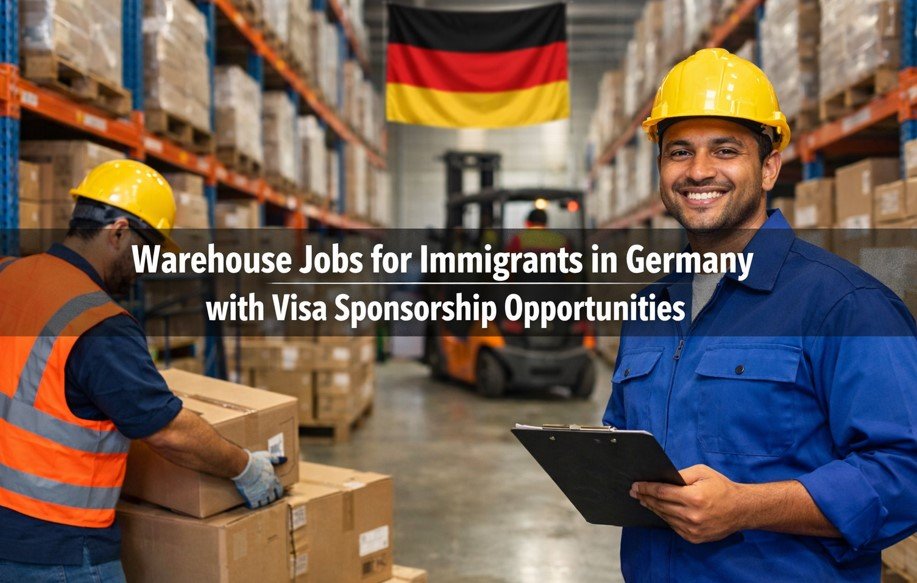
Finding warehouse jobs for immigrants in Germany has become a primary goal for many job seekers looking to enter Europe’s largest economy.
As the logistics powerhouse of the continent, Germany is currently facing a massive labor shortage in its supply chain sector, creating a unique window of opportunity for international workers.
Warehouse jobs for immigrants in Germany offer more than just a paycheck; they provide a gateway to a residency permit through various visa sponsorship pathways that have been significantly simplified as of 2026.
Whether you are looking for entry-level packing roles or specialized forklift operations, the German government’s recent legislative changes mean that the dream of working in a world-class logistics environment is more accessible than ever before.
Why Germany is the Top Choice for Logistics Workers in 2026
To truly understand why warehouse jobs for immigrants in Germany have become the gold standard for global logistics seekers in 2026, one must look at the convergence of economic necessity and progressive legislation.
Germany has transitioned from a country that simply “needed workers” to one that actively “invites talent,” creating a professional ecosystem that treats warehouse personnel as the backbone of the national economy.
Here is an expanded look at why Germany remains the premier destination for logistics professionals this year.
The Critical Labor Shortage and Job Security
The demand for warehouse jobs for immigrants in Germany is driven by a demographic shift that has left nearly every major distribution center understaffed. As the “Baby Boomer” generation retires from the German workforce, the logistics sector has seen a massive vacancy gap that local recruitment cannot fill.
In 2026, this labor shortage is no longer just a trend; it is a structural reality. For an immigrant, this translates into unprecedented job security. Unlike other markets where manual labor might be precarious, a warehouse contract in Germany often leads to a “permanent” status (Unbefristet) after a probationary period.
Employers are so desperate to retain reliable staff that they are offering better terms, including long-term stability that allows workers to plan their lives, bring their families, and integrate into the community without the constant fear of layoffs.
Unmatched Geographical Dominance in Europe
Germany is the undisputed “Logistics Heart” of the European Union. If you look at a map of European trade routes, all roads literally lead through Germany.
This central positioning means that global giants, from tech manufacturers to retail leaders, choose Germany as their primary European distribution hub. For someone seeking warehouse jobs for immigrants in Germany, this means you aren’t just working for a local shop; you are working at the intersection of global trade.
The sheer volume of goods moving through German ports and rail terminals ensures that the logistics industry is “recession-resistant.”
Even during global economic fluctuations, the flow of essential goods through German corridors remains constant, providing a steady stream of overtime opportunities and diverse roles across the supply chain.
The 2026 Legal Revolution: The Opportunity Card (Chancenkarte)
The most significant factor making Germany the top choice in 2026 is the legal ease of entry. The German government has fully implemented the Chancenkarte, or Opportunity Card, which uses a transparent points-based system similar to those in Canada or Australia.
This has revolutionized how immigrants access the labor market. Previously, securing a visa from abroad was a bureaucratic mountain; now, if you have a basic vocational background or relevant experience, you can obtain a visa to come to Germany and look for work on-site.
This “search phase” allows you to visit warehouses, meet managers, and ensure the working conditions meet your standards before signing a long-term contract. It removes the “middle-man” and puts the power back into the hands of the worker.
High Standard of Social Protections and Benefits
When you secure warehouse jobs for immigrants in Germany, you aren’t just getting a salary; you are entering one of the world’s most robust social safety nets. German labor laws are strictly enforced, ensuring that “warehouse help” is treated with the same dignity as office staff.
In 2026, the mandatory benefits package for a full-time warehouse employee includes comprehensive health insurance, nursing care insurance, and unemployment protection. Furthermore, the “Parental Leave” (Elternzeit) and “Paid Vacation” laws are among the best in the world.
Most logistics workers enjoy a minimum of 24 to 30 days of paid vacation per year, plus public holidays. This emphasis on “Work-Life Balance” is a cultural staple in Germany, ensuring that while you work hard, you have the time and financial means to enjoy your life outside the warehouse.
Automated Infrastructure and Skill Upgrading
Germany is a global leader in “Logistics 4.0.” Working in a German warehouse in 2026 often means working alongside state-of-the-art technology, including automated guided vehicles (AGVs), AI-driven sorting systems, and advanced wearable scanning tech.
For an immigrant, this provides an incredible opportunity for “upskilling.” You aren’t just moving boxes; you are learning to operate and troubleshoot high-tech systems.
German employers frequently invest in their staff through Weiterbildung (further education), paying for workers to get their heavy machinery licenses or logistics management certifications.
This transforms a “temporary job” into a high-tech career, making you more valuable in the global market and significantly increasing your earning potential over time.
Transparent Wage Growth and Inflation Adjustments
The financial landscape for warehouse jobs for immigrants in Germany has been bolstered by aggressive minimum wage adjustments and collective bargaining agreements. In 2026, the German government and trade unions (like Verdi) have ensured that wages in the logistics sector keep pace with the cost of living.
Many warehouses now operate under Tarifvertrag (collective agreements), which guarantee scheduled pay raises, “13th-month” bonuses (Christmas bonuses), and vacation pay.
Additionally, the “Night Shift Bonus” and “Sunday Bonus” remain tax-free up to certain limits, allowing diligent workers to significantly increase their net take-home pay simply by choosing less traditional shifts.
This transparency ensures that workers are never “stuck” at a starting wage but have a clear, documented path to financial growth.
Understanding Visa Sponsorship for Warehouse Jobs
In 2026, navigating the legal path to warehouse jobs for immigrants in Germany has been transformed by a suite of “pro-worker” laws designed to simplify entry.
While the term “visa sponsorship” is commonly used, it is better understood in Germany as a collaborative process where your employer provides the legal foundation, and the government provides the pathway.
Here is an in-depth expansion on the primary visa sponsorship mechanisms available for logistics workers this year.
The Opportunity Card (Chancenkarte)
The Chancenkarte is the flagship pathway for anyone seeking warehouse jobs for immigrants in Germany without a pre-existing job offer. In 2026, this points-based system allows you to legally enter the country for up to one year to find a permanent role.
To qualify, you must demonstrate a minimum of two years of vocational training or a university degree from your home country, along with basic language skills (German A1 or English B2).
The “sponsorship” here is essentially self-funded through a blocked account (requiring roughly €1,091 per month), but it grants you the immediate right to work up to 20 hours per week in a warehouse while you interview for full-time positions. This is the ultimate “foot in the door” for international workers.
Recognition Partnerships
For workers who have professional experience but lack a certificate that is immediately recognized as equivalent to a German Ausbildung, the Recognition Partnership (Anerkennungspartnerschaft) is a vital tool.
Under this scheme, a German employer can “sponsor” you by offering a contract despite your qualifications being in the process of evaluation. This allows you to enter Germany and begin working in a warehouse role immediately, provided that you and your employer commit to completing the official recognition process after your arrival.
This bridge removes the months of waiting traditionally required for document verification, making it one of the fastest ways to secure warehouse jobs for immigrants in Germany in 2026.
The Experience Pillar: Practical Skills Over Paperwork
In a major shift for 2026, Germany has expanded the Experience Pillar of the Skilled Immigration Act. This pathway is specifically designed for “experienced professionals” who may not have a formal degree but possess at least two years of practical work experience in the logistics or warehouse sector within the last five years.
To benefit from this, you need a job offer that meets a specific salary threshold, which for 2026 is approximately €45,934 annually (or less if the employer follows a collective bargaining agreement).
This pathway acknowledges that a veteran forklift operator or inventory manager with years of hands-on skill is just as valuable to the German economy as someone with a classroom-based diploma.
Western Balkans Regulation
For residents of Albania, Bosnia and Herzegovina, Kosovo, Montenegro, North Macedonia, and Serbia, the Western Balkans Regulation remains a cornerstone for accessing warehouse jobs for immigrants in Germany.
In 2026, the quota for this regulation has been permanently increased to accommodate the high demand for logistics personnel. Unlike other visas, this pathway does not strictly require formal vocational training or high-level language skills, making it the primary route for general warehouse assistants and packers.
The “sponsorship” involves the German Federal Employment Agency (BA) conducting a “priority check” to ensure no preferred domestic workers are available before approving your contract.
Fast-Track Procedure for Skilled Workers
If you have already secured a contract for a specialized role, such as a Warehouse Logistics Specialist or Shift Lead, your employer can initiate the Fast-Track Procedure for Skilled Workers (Beschleunigtes Fachkräfteverfahren).
By paying a fee of €411, the employer acts as your primary advocate, working directly with the local Foreigners’ Authority (Ausländerbehörde) to bundle all necessary approvals.
This process drastically reduces visa waiting times from several months to just a few weeks. In 2026, this is the preferred method for large-scale logistics firms looking to onboard international talent quickly to meet seasonal demands.
The EU Blue Card
While most associate the Blue Card with IT or engineering, it is also applicable to senior-level warehouse jobs for immigrants in Germany, such as Supply Chain Managers or Logistics Operations Directors. In 2026, the salary thresholds for the Blue Card have been lowered to make it more accessible.
If your role is considered a “shortage occupation”, which now includes several logistics management categories, the required gross annual salary is approximately €45,934.
The Blue Card is the “gold standard” of sponsorship because it allows for faster permanent residency (often in as little as 21 months) and offers the easiest process for bringing family members to Germany.
Warehouse Jobs for Immigrants in Germany with Visa Sponsorship Opportunities
In 2026, the landscape for warehouse jobs for immigrants in Germany is vast, ranging from entry-level physical roles to high-tech management positions.
Each of these roles offers a pathway to German residency, particularly through the updated “Experience Pillar” and the “Chancenkarte.”
Here are some of the specialized warehouse roles currently in high demand with visa sponsorship opportunities:
1. Warehouse Operative (Lagerhelfer)
Average Salary: €30,000 – €35,000 per year
As the most accessible entry point for warehouse jobs for immigrants in Germany, the Warehouse Operative role focuses on general labor such as sorting, moving, and stacking goods.
Because this is a “bottleneck” occupation in 2026, many large-scale distribution centers are willing to provide the necessary employment contracts for a work visa even if the applicant has limited experience.
This role is ideal for those utilizing the Western Balkans Regulation or the Opportunity Card, as it requires minimal German language skills (A1 or A2) and offers a fast-track into the German social security system.
2. Order Picker (Kommissionierer)
Average Salary: €31,000 – €36,000 per year
Order Pickers are the lifeblood of Germany’s e-commerce giants, responsible for navigating massive aisles to collect specific items for customer shipments.
In 2026, these warehouse jobs for immigrants in Germany often involve using “Pick-by-Voice” or “Pick-by-Light” technology, which can be operated in English or basic German.
Companies like Amazon and DHL frequently “sponsor” international applicants by providing binding job offers that satisfy the requirements for the Skilled Immigration Act’s “practical knowledge” pathway, especially for those who can show a history of high-speed retail or logistics work.
3. Forklift Operator (Gabelstaplerfahrer)
Average Salary: €34,000 – €40,000 per year
Securing a role as a Forklift Operator is one of the most reliable ways to get a visa, as it is classified as a “skilled trade assistant” role. To qualify for warehouse jobs for immigrants in Germany in this category, you typically need a Staplerschein (Forklift License).
If you have a license from your home country, German employers in 2026 often use the “Recognition Partnership” to bring you to Germany on a visa while you complete a short 2-day conversion course to meet German safety standards. This role offers significantly higher pay and better job security than general picking or packing.
4. Shipping and Receiving Clerk (Versandmitarbeiter)
Average Salary: €32,000 – €38,000 per year
This role involves the meticulous documentation of incoming and outgoing freight, ensuring that all paperwork matches the physical inventory.
For immigrants, this is an excellent role because it combines physical warehouse work with administrative tasks, making it a great “bridge” to management. Sponsorship is common here because German logistics hubs need workers who are detail-oriented and can handle digital inventory systems.
In 2026, many international shipping firms prioritize bilingual candidates for these roles, making your native language a competitive advantage for your visa application.
5. Inventory Controller (Bestandskontrolleur)
Average Salary: €38,000 – €48,000 per year
Inventory Controllers are responsible for the accuracy of the warehouse’s stock levels, performing regular audits and using Warehouse Management Systems (WMS) like SAP. These are considered highly skilled warehouse jobs for immigrants in Germany.
Because this role requires specific technical knowledge, it often qualifies for the Skilled Worker Visa under the “academic or vocational” pillar.
Employers are highly motivated to sponsor these workers as a single inventory error can cost a company thousands of euros, making a reliable, experienced immigrant controller a valuable asset.
6. Warehouse Packer (Verpacker)
Average Salary: €30,000 – €34,500 per year
Packers ensure that items are safely secured and labeled according to international shipping regulations. While often seen as entry-level, the high demand in 2026 has led many companies to offer “relocation packages” and visa support for groups of workers from outside the EU.
These warehouse jobs for immigrants in Germany are frequently available in the pharmaceutical and automotive sectors, where specialized packing (such as climate-controlled or hazardous material packing) is required, allowing workers to qualify for visas based on their “specialized practical experience.”
7. Logistics Coordinator (Logistikkoordinator)
Average Salary: €42,000 – €55,000 per year
A Logistics Coordinator manages the flow of goods between the warehouse and the transport fleet, often dealing with international suppliers.
In 2026, this role is a prime candidate for the EU Blue Card if the salary threshold is met, as it falls under the “Shortage Occupation” list for transport and distribution managers.
Immigrants with a degree in business or logistics can find rapid sponsorship because of their ability to communicate with international stakeholders, making them indispensable to German firms looking to expand their global footprint.
8. Shift Supervisor (Schichtleiter)
Average Salary: €45,000 – €58,000 per year
Supervisors manage teams of 20 to 50 warehouse workers, ensuring safety protocols and productivity targets are met.
For immigrants who have previous management experience in their home countries, this is one of the best warehouse jobs for immigrants in Germany to apply for. Sponsorship is almost always available for this level of seniority, as the “leadership gap” in German logistics is critical in 2026.
Employers will often fast-track your visa application using the “Accelerated Procedure for Skilled Workers” to get you on the floor as quickly as possible.
9. Material Handler (Materialverwalter)
Average Salary: €33,000 – €39,000 per year
Material Handlers are specialists who ensure that production lines (particularly in the automotive or machinery sectors) never run out of parts. This role requires a high degree of integration with the warehouse’s internal software.
As Germany remains a manufacturing powerhouse in 2026, these warehouse jobs for immigrants in Germany are abundant in the industrial corridors.
Sponsorship is likely if you have experience with automated guided vehicles (AGVs) or robotic sorting systems, as these technical skills are highly prized by German manufacturing giants like Bosch or Siemens.
10. Quality Assurance Inspector (Qualitätskontrolleur)
Average Salary: €36,000 – €45,000 per year
Quality Assurance (QA) Inspectors check goods for defects before they are shipped to customers. In the era of high-speed e-commerce, maintaining a low return rate is vital.
These warehouse jobs for immigrants in Germany are often sought by those with technical backgrounds or experience in manufacturing.
Because QA is a specialized function, it is much easier to justify a visa sponsorship to the Federal Employment Agency, as the role requires a level of “qualified expertise” that goes beyond general warehouse help.
11. Warehouse Administrator (Lageradministrator)
Average Salary: €35,000 – €43,000 per year
Focusing almost entirely on the digital side of logistics, administrators manage schedules, process orders, and handle customs documentation.
This is an ideal role for immigrants who have strong computer skills but may not want the heavy physical toll of picking or packing. In 2026, many German companies are digitizing their entire supply chain, and they need workers who can manage complex databases.
If you have experience with SAP or Oracle, your chances of finding a company to sponsor your work visa are exceptionally high.
12. Supply Chain Analyst (Supply-Chain-Analyst)
Average Salary: €55,000 – €75,000 per year
This is a high-level strategic role that involves using data to optimize the entire warehouse operation. In 2026, this role easily qualifies for the EU Blue Card due to the high salary and the “shortage” status of data-driven logistics roles.
Immigrants with a background in mathematics, statistics, or logistics engineering can expect full visa sponsorship, relocation assistance, and a pathway to permanent residency in less than two years. It is one of the most prestigious warehouse jobs for immigrants in Germany.
13. Returns Processor (Retourenmitarbeiter)
Average Salary: €31,000 – €36,000 per year
With the explosion of online shopping, “reverse logistics” (handling returns) has become a massive sub-sector. Returns Processors inspect returned items, decide if they can be resold, and re-enter them into the system.
For immigrants, these roles are plentiful and often come with lower language requirements than customer-facing roles. Many large retail warehouses in 2026 offer visa sponsorship for this role because of the constant volume of work, providing a stable, climate-controlled environment for international workers.
15. Customs Specialist (Zollabwickler)
Average Salary: €48,000 – €62,000 per year
As Germany handles a vast amount of trade with non-EU countries, Customs Specialists are essential for ensuring that all legal and tax requirements are met for shipments. This is a highly specialized role that requires knowledge of international trade law.
For an immigrant, having knowledge of both German customs and the customs of your home country (e.g., Turkey, India, or China) makes you a “unicorn” candidate.
These warehouse jobs for immigrants in Germany almost always come with full visa sponsorship and high-tier benefits because of the legal complexity and responsibility involved.
Conclusion
The demand for warehouse jobs for immigrants in Germany is at an all-time high. With the 2026 updates to the Opportunity Card and the Skilled Immigration Act, the barriers to entry have never been lower. By focusing on reliable companies, preparing a professional German-style application, and being willing to learn the basics of the language, you can secure a stable future in one of the world’s most robust economies.